
The match-up recruitment post is the first document IP holders use to decide, "Should I partner with this brand?"
No matter how good a brand is, if the content is lacking and vague, IP holders will hesitate to provide support.
Conversely, posts that specifically detail what product you want to create and under what conditions you want to collaborate lead IP holders to contact you first, resulting in a flood of recruitment.
Today, I will show you how to write a recruitment post for product production and licensing type matchups, so that even first-time brand partners can follow along immediately.


Product production and licensing involve the direct manufacturing of physical or digital goods utilizing characters.It is a type of collaboration where the rights to distribute and sell are granted by the IP holder.
Rather than a one-off collaboration that ends after a single production, we are demonstrating a long-term structure of consistent production and sales throughout the contract period.
If you are aiming for a long run, like steady-selling merchandise or brand licensed products, this is the most suitable type.
TIP
If you want short-term events or season-limited collaborationsShort-term commercialization and collaborationThe type is more suitable.

When you start writing a recruitment post for a matchup, you need to fill out the project overview thoroughly.
This is because the first thing IP holders check in a matchup is the brand's identity.

It is good to include three things in this item.
1️⃣ Please briefly describe what product you are making and which customers you are targeting.
2️⃣Please describe the brand's strengths in detail, such as production capabilities, distribution networks, and the number of sales outlets, and explain 'why our brand is a trustworthy partner.'
3️⃣Please describe what you intend to achieve through this collaboration and which IP holders you would like to partner with, and share your future direction.
Especially since this is a long-term collaboration, going beyond simply stating your desire to use the characters and including specific objectives and directions for how you plan to sustainably operate them can build much greater trust with the IP holder.

It is the most important factor for the IP holder when evaluating contract terms.
The key here is to write it 'accurately'.
Many brand partners often write their collaboration conditions vaguely, thinking, "Our collaboration terms aren't specific yet, so let's not write them down," or "Wouldn't disclosing the terms actually result in not receiving support?"
However, you need to be specific about what the product is and what collaboration plans you have to build trust with the IP holder and encourage their support.

In particular, collaboration conditions play a very decisive role when applying for a match.
First, for the IP holder to determine if this matchup is beneficial to them, they need the products, quantities, and royalty rates.
Second, if the IP holder is already engaged in collaboration in a similar category, it may constitute a breach of contract.
Therefore, it is important for both parties to clearly notify each other of the product and category in advance.
Even if you do not have specific production quantities or royalty rates, it is efficient to write down your desired range in advance.

Don't forget to write down the brand's desired direction in detail.
Rather than vaguely stating that you are looking for a 'cute character,' please consider who the character's main fanbase is, which media they primarily operate on, and how their sensibility and worldview can connect with your brand's customer base.
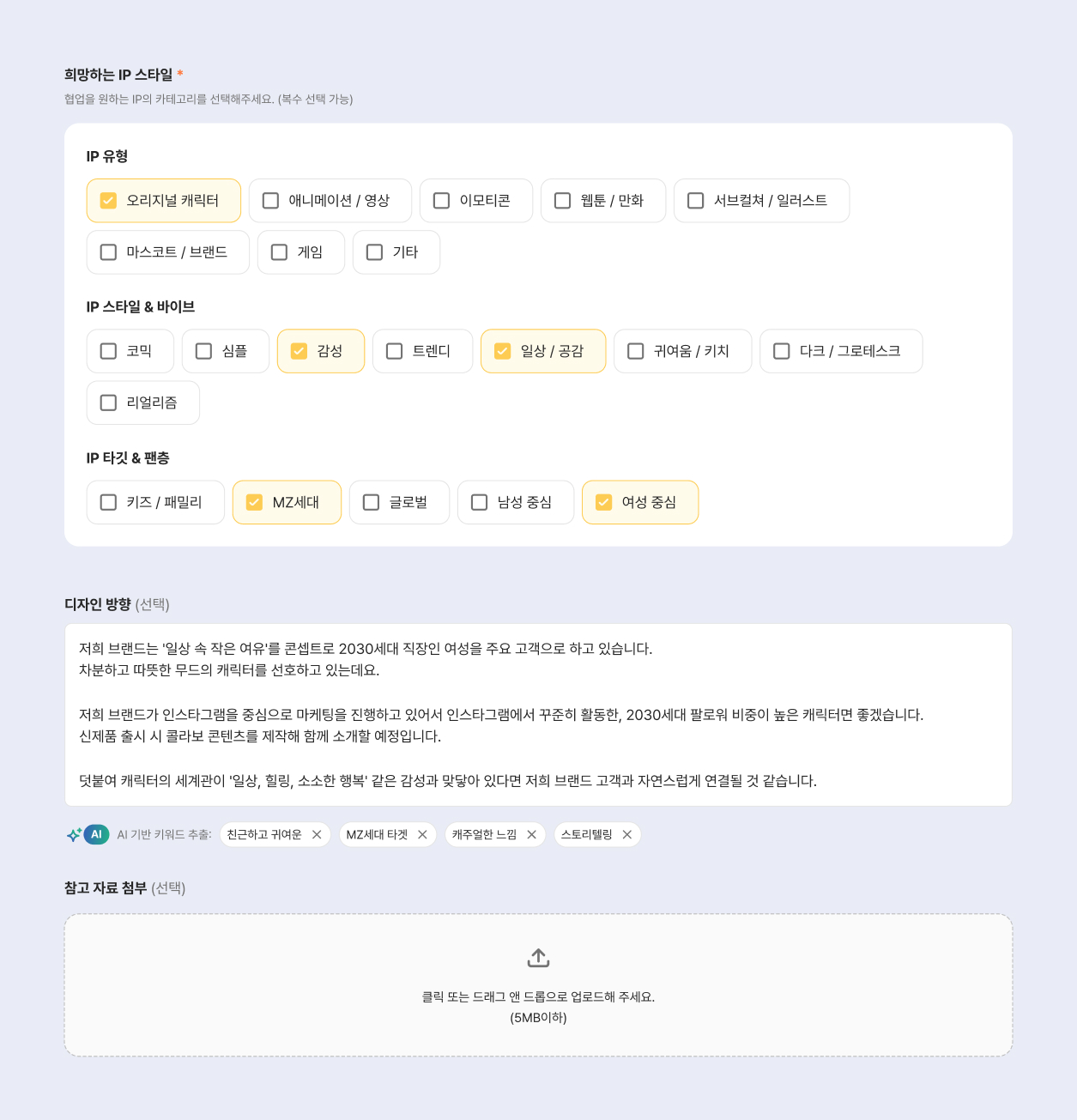
The more detailed you explain the brand's direction, the more the IP holder can determine for themselves whether it aligns with our brand, reducing unnecessary coordination processes.
If it is difficult to specifically describe the desired character, it is also a good idea to write down the brand's direction in detail.
If you clearly explain, "Our brand delivers these values to these types of customers," IP holders can judge the fit for themselves.
TIP
Before writing down your desired direction, please answer the questions below.
Who would you like the main fanbase of the character you want to work with to be? e.g., women in their 20s, kidults, Gen Z
On which media will you primarily promote your collaboration with the character? e.g., Instagram, YouTube, offline pop-ups
What are the character's sensibilities, values, and worldview like?
Is there any overlap with our brand's target audience?


Please specify in detail the benefits that can be provided to IP holders in addition to royalties.
The clearer the benefits, the better the value of Matchup is conveyed to IP holders.
Provision of finished product samples, credit inclusion on product packaging and detail pages, character via brand social media It can include introductions, etc.
Especially since it is a long-term contract, the commitment to regularly share sales performance reports is a benefit that builds trust.


Budget items in product production and license types areIt is much better to write down at least a rough estimate rather than just saying 'negotiable'.
It's okay if you haven't decided on the exact amount yet.
From the perspective of an IP holder, if there is no monetary range at all, it is difficult to even decide whether or not to apply for this collaboration.
So, showing a rough budget range can increase the support rate.
In addition, it is a good idea to schedule your desired itinerary with plenty of leeway.
IP holders also need sufficient time for design work, and collaboration with a tight schedule makes them hesitate to apply.
If you want high-quality collaboration, it is advantageous for both parties to schedule a generous timeframe.
TIP
It is a good idea to organize any additional requests as specifically as possible.
You need to align the conditions with each other during the pre-collaboration phase so that communication bottlenecks do not occur when you actually start working together.
You must fully align each other's conditions and expectations before collaboration begins to ensure the project continues stably during the actual implementation phase, without unnecessary communication delays or bottlenecks.
There are times when people hastily send additional requests, thinking, "I can just ask the IP holder later."
This approach not only affects the schedule but can also give IP holders the impression that they are not being sufficiently respected.
Since even small differences in communication styles can determine the overall atmosphere of the collaboration, it is important to organize and agree on necessary details in advance.

Product manufacturing licenses are not short-term collaborations.
Since IP holders are also choosing long-term partners, the brand's seriousness and preparedness must be conveyed in the match-up recruitment post.
If you use just these five things properly, the quality of your recruitment post will change dramatically.
If you are feeling lost due to dropping support rates or repeated registration delays, check out this guide and try following it.
A well-prepared recruitment post is the first step to meeting IP holders who will be with you for a long time.
How about these characters?