

The way brand partners view character portfolios is much faster and more intuitive than IP holders think.
It compares multiple IPs simultaneously and makes a decision in a short amount of time that "this IP is a good match for us."
In this case, the criterion is not simple taste or sentiment, but the potential for what kind of results can actually be produced when working together.
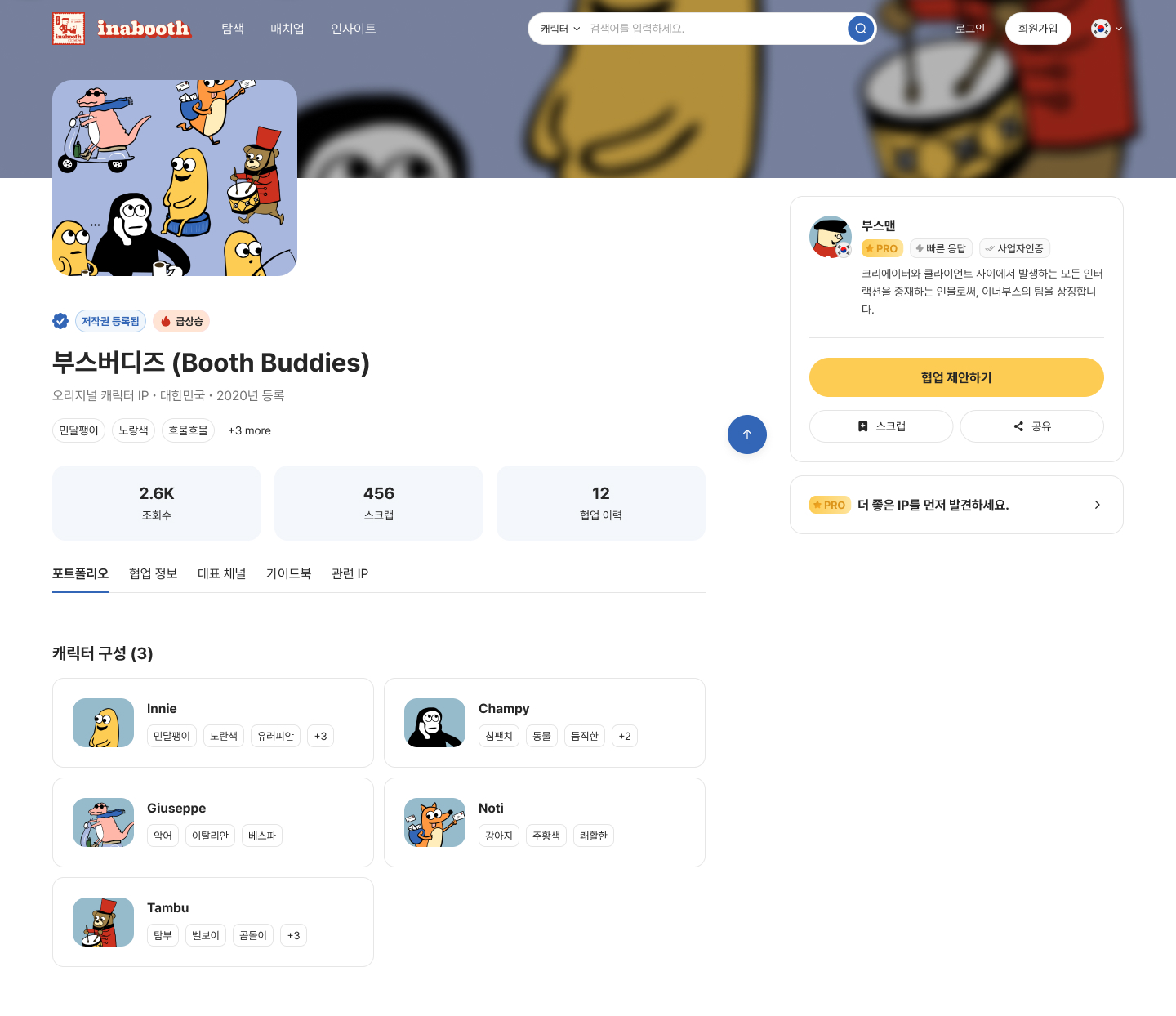
So, if you have a positive response on social media and a steady increase in fans but it isn't leading to collaborations, it is highly likely that the portfolio is not functioning properly rather than an issue with the IP itself.
This is because while many IP holders view a portfolio merely as a space to showcase their IP, from a brand partner's perspective, it serves more as a criterion for determining ‘what results can be achieved by utilizing this IP.’
Understanding this difference will naturally change the way you structure your portfolio.
It shifts from simply listing well-made images to a structure that solves the issues brand partners are concerned about on their behalf.
And this change also becomes the biggest turning point leading to actual collaboration.

The moment a brand partner sees IP, the first thing that comes to mind is, ‘Where can I use this?’
However, if your portfolio only contains original IP artwork or illustrations, you end up having to imagine every possible application scenario in your head.
If this process is not easy, you naturally move on to the next IP, and ultimately, the opportunity itself is not created.
Conversely, if usage scenarios are presented together, the story changes completely.
Because you can immediately connect actual applications such as product packaging, merchandise, app screens, and campaign images as soon as you see the IP, the picture of the collaboration becomes much more concrete.

So, it is best if you have images of the actual merchandise produced, but if you do not have any collaboration experience yet, using mockup images alone can be enough to create a sufficient effect.
The important thing is to show the message "This IP can be used like this" as an image.
Ultimately, showing what the brand partner would otherwise have to imagine—this single thing significantly changes the persuasiveness of the portfolio.

When introducing IP, expressions such as "the response is good" or "we have many fans" are frequently used. While these sentences sound natural from the perspective of the IP holder, they are difficult to use as a standard of judgment from the perspective of the brand partner.
The reason is that the criteria for viewing IPs are different.
Brand partners want IP that can produce good results, rather than simply cute and popular IP that fits the brand well.
In other words, because brand partners expect tangible results through collaboration, they seek evidence to objectively verify that potential.
In this situation, the most intuitive element is numbers.

You can convey the character's current status much more clearly by showing everything from basic metrics like follower count, likes, and comments to trends such as growth rates and engagement rates over the past few months.
The important thing here is not simply listing the numbers, but conveying what kind of changes those numbers represent.
For example, even if the follower count itself is not large, if it has been growing rapidly over the past few months, brand partners are highly likely to perceive it as a ‘trending IP that is currently skyrocketing.’
As such, data acts not merely as a supplementary means to explain the appeal of IP, but as a key factor in judging the potential for collaboration.
So, rather than adding emotional explanations, organizing based on numbers that show the flow is conveyed much more persuasively.
TIP
In Inner Booth, if you register a representative channel, key metrics such as content upload count, reactions, and engagement rate are automatically updated.
Thanks to this, the moment brand partners check the portfolio, they always see the latest data and naturally get the impression that the IP is still active.

When creating a portfolio, it may feel like keeping every brand in mind will give you more opportunities, but in reality, the opposite often happens.
Since each brand has a different customer base and direction, a portfolio that does not consider a specific target is likely to end up not clearly fitting any brand.
So, first, it is necessary to go through a process of specifically identifying who the fans who like my character are.

If you examine the age groups, interests, consumption styles, and content response patterns of the IP one by one, you will naturally start to see the types of brands that are a good fit for this IP.
And when this information is integrated into the portfolio, brand partners with similar targets will resonate with it much faster.
Ultimately, the goal of a portfolio is not to be exposed to as many places as possible, but to reach the right place precisely.
You must remember that the moment this direction is established, the density of the collaboration proposal itself begins to change.

One of the biggest factors when a brand partner decides to collaborate is whether they have already collaborated with other places.
Actual collaboration history serves as verification in itself, making it an important criterion for leading to future collaborations.
However, if you manually update your portfolio every time a collaboration occurs, it is easy for details to be missed or for brand partners to be slow in making decisions regarding the collaboration.

Fortunately, collaboration history within the Inner Booth is automatically reflected in your portfolio, so you can keep it up to date without having to manage it separately.
As time goes by, collaboration cases naturally accumulate, creating a structure where that itself continuously enhances the persuasiveness of the portfolio.

When a brand partner begins to specifically review a collaboration, they will request materials such as character guidebooks, turnarounds, and color palettes.
At this point, if the materials are not prepared or need to be delivered separately, the flow of the discussion is naturally interrupted.

Conversely, if the necessary materials are organized within the portfolio, the brand partner can check them immediately without a separate request, which speeds up the process.
In this process, the IP holder gives the impression that they are well-prepared for collaboration, and that itself leads to trust.
The Innerbooth portfolio is structured to allow you to manage these materials in one place, so you can naturally check all the information within the flow of viewing the portfolio.
TIP
The Innerbooth portfolio is structured to allow you to manage these materials in one place, so you can naturally check all the information within the flow of viewing the portfolio.

A portfolio is not just a page for organizing IP.
It is the final criterion that brand partners check before deciding on a collaboration.
Even with the same IP, the opportunities can vary completely depending on how it is presented.
If your IP is receiving a positive response but isn't leading to collaboration, it's a good idea to check whether your portfolio is stuck at just ‘introducing IP’ or if it is leading to ‘persuasion.’
How about these characters?