

If you are a brand planning to purchase and sell pre-existing character merchandise, you need to change the way you create your matchups.
This is because, unlike collaborations that plan new products using characters, this type aims to distribute finished products, so the criteria for verification by the IP holder also differ.
Through this matchup, IP holders first see ‘on which channels and in what ways this brand can sell our products.’
Evidence of how well it can actually be sold plays a more important role than mere purchase intent.
Therefore, it is recommended to structure the recruitment post in a way that reveals sales channels, distribution structure, and operational methods, rather than focusing on the brand introduction.
Today, I will explain in detail how to write a recruitment post for a match that suits the types of product purchases made for distribution purposes.


Purchasing products for distribution purposes is a transaction in which IP licensed products that have already been produced are purchased and resold through online commerce or offline distribution networks.
It is a method of purchasing and distributing existing products rather than planning new character designs or manufacturing products directly.
Settlement is also conducted via a B2B purchasing method where the unit purchase price is paid, so it proceeds as a simple product purchase transaction rather than royalties or fixed amounts.
So, even in recruitment posts, it is better to focus on 'which channels and how much you can sell' rather than 'what kind of character you want.'

The first thing IP holders look at in a recruitment post is whether 'this brand partner can properly sell our products.'
Therefore, rather than simply introducing the brand, it is better to provide specific details regarding the scale of the distribution channels and your operational experience.

If you include information on which platform you sell on, your average monthly transaction volume or number of visitors, and if you have offline stores, the number and locations of those branches, IP holders will feel more confident in you as a brand partner and find it easier to apply.
From the perspective of an IP holder, the number of consumers their product reaches has a significant impact, so it is highly recommended to mention any previous experience in distributing IP products.

This is the key factor that IP holders decide to apply for Matchup.
Please be as specific as possible about which product you would like to purchase, how much, and at what price range.

At this point, you need to specify the desired product category and item, the desired purchase quantity (based on the initial order), and the desired purchase price range.
It is a good idea to write down a desired range for quantity and unit price, even if they are not finalized.
This is because IP holders need minimum standards to determine whether this transaction is profitable.
If you also indicate whether reorders are possible, you can demonstrate the potential for long-term transactions to the IP holder.

In distribution transactions, a deal is only completed when the budget and the receiving schedule align, which is why a match-up can be meaningful.
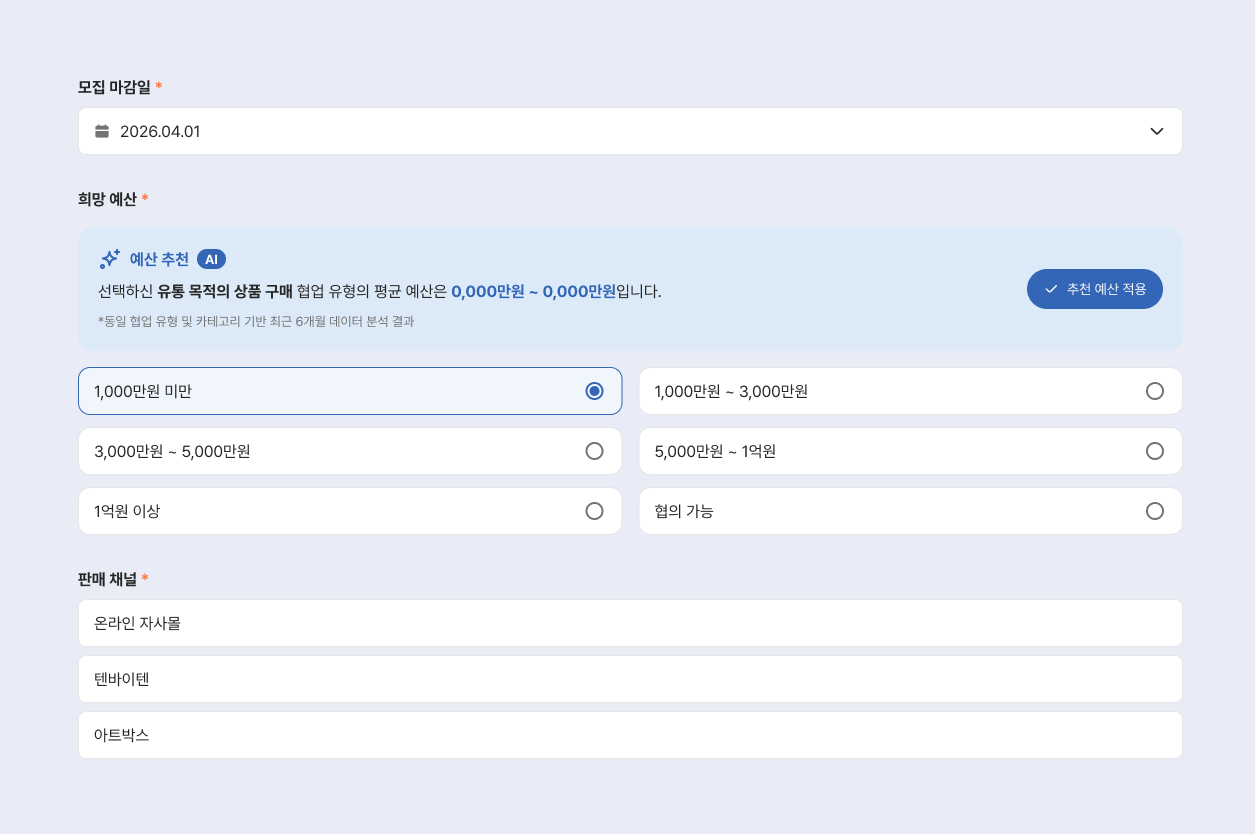
From the IP holder's perspective, they also need to know in advance how much quantity needs to be prepared and by when in order to formulate production and shipment plans.
It is much easier for the IP holder to make a judgment if you organize the two things together.

For the receiving schedule, please include the desired receiving time along with a margin for delivery.
The more sufficient time you give IP holders to prepare and ship inventory, the smoother the match-up support proceeds.

While purchasing goods for distribution purposes may appear like a simple transaction, from the IP holder's perspective, it is a process of finding a sales partner they can trust with their products.
Where and how you sell is just as important as how much you buy.
Simply writing down the scale of your distribution channels and sales plans in detail can clearly differentiate you from other brand partners.
If you are disappointed with the low support rate, please check this guide one more time before posting a matchup on the inner booth.
A well-prepared recruitment post is the first step to finding IP products that are the perfect fit for our channel.
How about these characters?