

August 18, 2026
When engaging in IP licensing (collaboration), both the party receiving the proposal and the party making it face similar issues. From the perspective of the IP owner and operator, every time a collaboration inquiry comes in, they must re-verify necessary information such as products, quantities, schedules, and sales channels one by one.
Conversely, brands proposing collaborations often request additional materials after sending an email and only begin negotiating specific terms after several rounds of communication. There is a simplest way to shorten this process.
as soon as Standardizing the ‘Commercialization Plan’no see.
- If you received a collaboration offerRequest the partner company to prepare a product commercialization plan, and
- If I were to propose a collaborationIt is a method of preparing the necessary details in advance and delivering them along with the initial proposal.
If you exchange information based on a single documentProposal → Review → Negotiation of Terms → ContractYou can make communication much more efficient. Inner Booth has prepared an IP commercialization plan template that can be immediately used in practical IP licensing and collaboration work.
🤚Wait, why is a commercialization plan necessary?

We would like to collaborate with your IP.
It is a good start, but there is insufficient information to assess the actual feasibility of licensing. The party receiving the proposal immediately raises several questions.
What kind of product do you plan to make?
When will it be released?
How many do you plan to produce and sell?
Where is it sold?
What is the estimated selling price?
This information is necessary to determine whether there is any overlap with existing contracts or product categories, whether there are any issues with the launch schedule, and the scale of the business, in order to discuss specific license terms. A commercialization plan is not merely a proposal explaining an idea;Document to move a collaboration idea to the actual ‘business review’ stageno see.
If you are the one receiving the proposal, request the necessary information first.

As IP grows and collaboration inquiries increase, it becomes inefficient to start every proposal with a meeting. Receiving a commercialization plan first allows you to review incoming proposals using the same criteria.
① You can quickly assess the potential for actual commercialization.
You can check whether it is currently just an idea stage or if concrete plans for production and distribution are prepared.
② You can systematically manage product categories.
You can check in advance whether there is a possibility of overlap or conflict with product lines and existing license agreements.
③ You can grasp the release schedule and distribution channels at a glance.
You can check the launch plans of various partners and manage them along with the IP's annual business and marketing schedule.
④ You can review the contract terms based on expected revenue.
We can estimate the royalty amount based on the expected sales price and sales volume, and discuss specific conditions such as MG and royalty rate.
As licensing agreements increase, the commercialization plan is not merely a form for receiving proposals, butBasic data for managing contracts, products, launches, and revenueIt becomes.
🏢 If you are a brand proposing a collaboration, please provide information for us to review first.

Conversely, if you are in the position of discovering a desired IP and proposing a collaboration, the commercialization plan isMaterials to accelerate consultationIt becomes.
Before I think it would be fun to collaborate with our brand.
After We are planning three clothing items utilizing this IP and intend to produce an initial batch of 5,000 units for sale on our online store and major offline stores, with a target launch date in October.
If you provide the information necessary for review, such as products, schedules, quantities, and sales channels, from the beginning, the other party will also internallyQuickly determine feasibility and conditionsIt is possible. Furthermore, simply delivering a concrete business plan goes beyond the level of a simple idea.The fact that it is a brand preparing for actual commercializationYou can show.
A good collaboration proposal is more than a flashy documentHow well the information needed for the other party to make a decision is organizedIt is important.
So, what should be included in the commercialization plan?
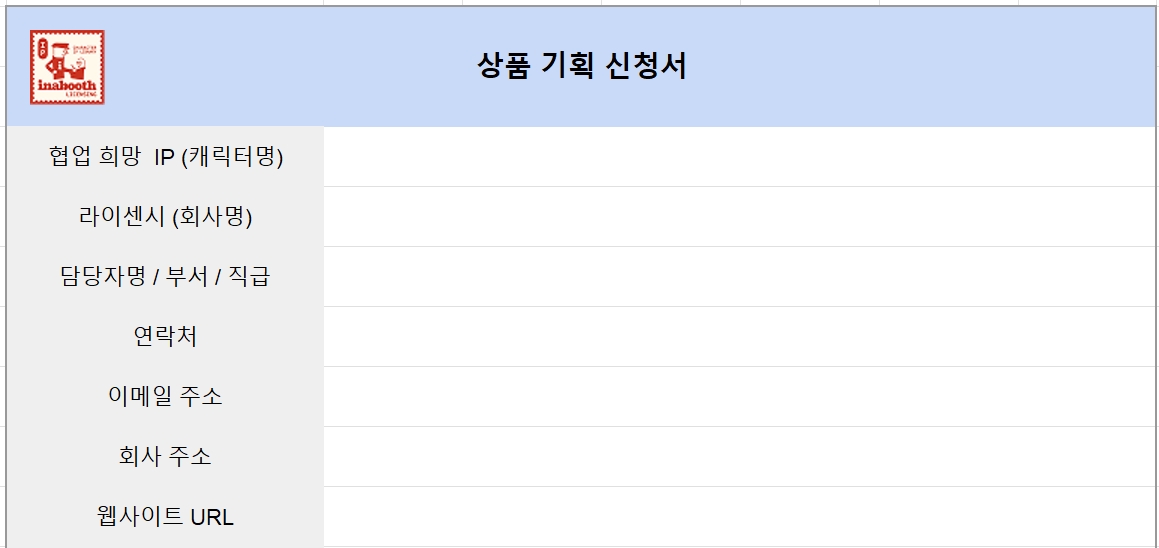
The information required for the review can be broadly categorized into six points. While they may seem obvious individually, once organized and presented from the start, this information significantly reduces consultation time.
item | Contents to include |
|---|---|
Proposed Company Information | Who makes the proposal? ex. Company/Brand Introduction, Contact Person, Major Sales Channels, Previous Collaboration Examples |
Products and Categories | What product will be produced? ex. Product name, specific category (Fashion → Bag → Mini Crossbody Bag), expected SKU, IP utilization method |
Expected release schedule | Specific release schedule and timeline for each process e.g., Target timeline from Contract → Design Development → IP Verification → Production → Release |
Sales Price · Sales Quantity | Estimated consumer price, initial production quantity, annual target sales quantity, projected sales volume |
Sales and distribution channels | Company-owned online stores, open markets, department stores, select shops, pop-up stores, overseas distribution, etc. |
Desired license conditions | Desired contract period, category, sales region, estimated royalty rate, whether to offer an MG |
There is no need to finalize all conditions from the start. The purpose of a commercialization plan is not to fix the terms, but to enable both parties to begin full-scale negotiations based on the same information.
Standardize everything from product commercialization plans to licensing tasks.
If you exchange information based on the commercialization plan, the overall workflow also becomes clear.
Collaboration Inquiry/Proposal → Preparation of Merchandise Plan → Review of Business Feasibility/Category → Negotiation of License Terms → Contract → Design/IP Verification → Production/Launch → Sales/Royalty Settlement

The receiving party can compare and manage various collaborations based on the same criteria, and the proposing brand can reduce unnecessary communication and shorten the time to full-scale negotiations by providing the information necessary for review in advance.
Ultimately, what matters isIt is not about creating a ‘great proposal,’ but about creating information that allows both parties to quickly make a judgment and move on to the next step.no see.
NEXT. How much will the actual profit be from this collaboration?

If you have already written the selling price and estimated sales quantity in the product commercialization plan, nowIt is time to review business feasibility with numbers.The IP provider must verify expected royalty revenue, while the product planning and sales provider must verify expected profitability reflecting royalties and costs.
Daum Insights provides a free IP licensing monetization simulation table that calculates estimated revenue by inputting sales price, sales quantity, cost, royalty rate, etc.
You May Also Like

August 11, 2026
January 7, 2026

November 26, 2025
How about these characters?