
April 4, 2024
What if you are a character IP holder who has just started selling merchandise?!
We provide easy-to-understand, correct tax knowledge that is essential for small business IP holders and companies!
I will explain everything step-by-step, from the difference between simplified and general taxpayers to the reasons and methods for issuing cash receipts and the proper way to use your account, so please take your time and follow along 😆

A simplified taxpayer refers to a business owner whose annual sales are between 48 million won and less than 80 million won.
Simplified taxpayers can receive various tax benefits regarding income tax and value-added tax, and in particular, the calculation of value-added tax is simplified.
Simplified taxation applies if the total amount of consideration for supplies in the previous year is less than 80 million won.
Businesses whose total amount in the previous year was less than 48 million won are not obligated to issue tax invoices, but are required to issue cash receipts.
A general taxpayer is a business operator with annual sales of 80 million won or more, and a tax rate of 10% applies.
You can deduct the full amount of value-added tax on the purchase tax invoice received when purchasing goods, etc.
In addition, since tax invoices can be issued, there are cases where it is considered advantageous to be a general taxpayer eligible for VAT refunds, especially when initial business costs are high.
People who receive a cash receipt from a simplified taxpayer cannot deduct the value-added tax indicated on the cash receipt.
The difference between simplified taxpayers and general taxpayers lies only in value-added tax, and there is no difference in income tax, constitutional tax, etc.
Since many character IP holders operate as simplified taxpayers, please ensure that cash receipts are issued correctly!
Generally, when purchasing goods or services with cash, many consumers provide the business with their receipt card or mobile phone number and request the issuance of a cash receipt.
A cash receipt refers to a receipt issued for an amount paid in cash.
When a cash receipt is issued, the details of the cash payment are reported to the National Tax Service, and consumers can receive tax-saving benefits during the year-end tax settlement by receiving a cash receipt.
If you are reading this and hold a business registration certificate, and belong to an industry subject to mandatory issuance, you are required to issue cash receipts.
※ Whether it falls under the category of industries with mandatory issuance responsibilitiesNational Tax Service HometaxYou can check it at.
Since cash receipts are used as proof of expenditure, if a consumer requests one, you must not refuse and make sure to issue it.
If a business owner does not issue a cash receipt or refuses to issue one, the National Tax Service will be unable to assess the accurate tax, so they may be reported for tax evasion.
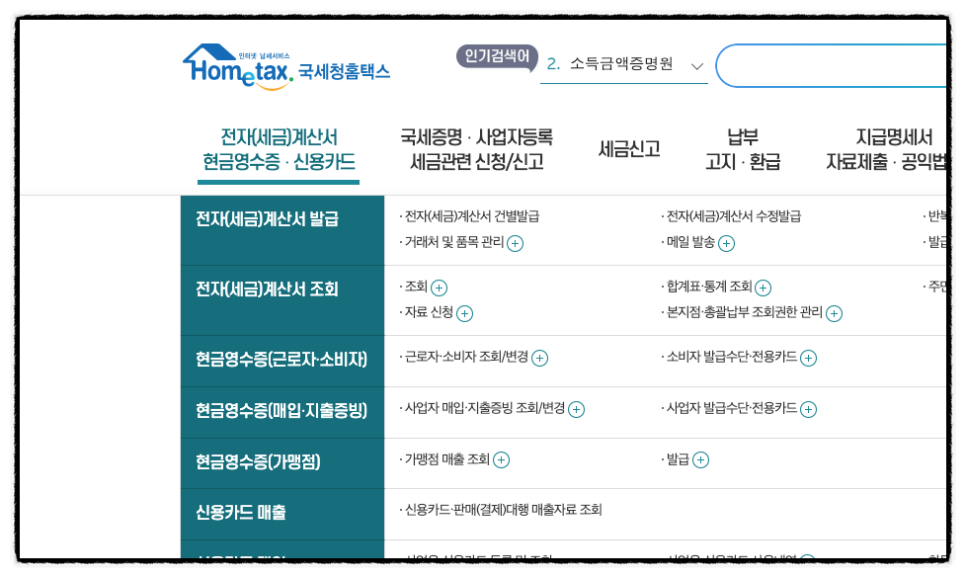
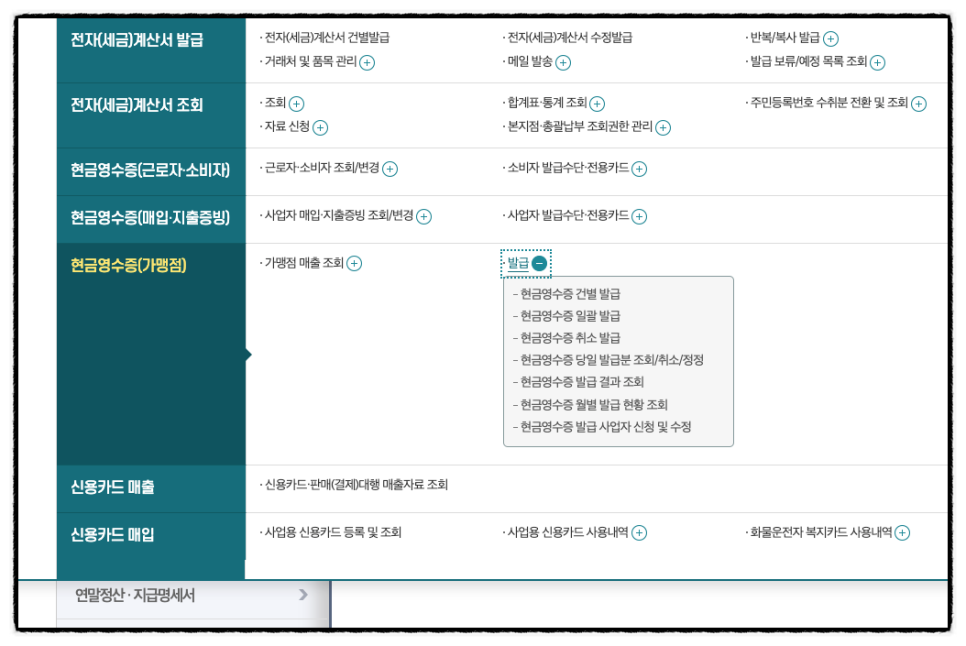
If you don't have a card payment terminal yet? Please proceed as follows!
National Tax Service HometaxPlease access and log in.
After logging in, go to [Electronic Tax Invoice/Cash Receipt, Credit Card] → [Cash Receipt (Merchant)], click [Issue], and select [Issue Cash Receipt per Transaction].
※ If you are issuing a cash receipt for the first time, please click [Issue] in [Cash Receipt (Merchant)] and proceed with the application first through [Application and Modification of Cash Receipt Issuing Business Operator].
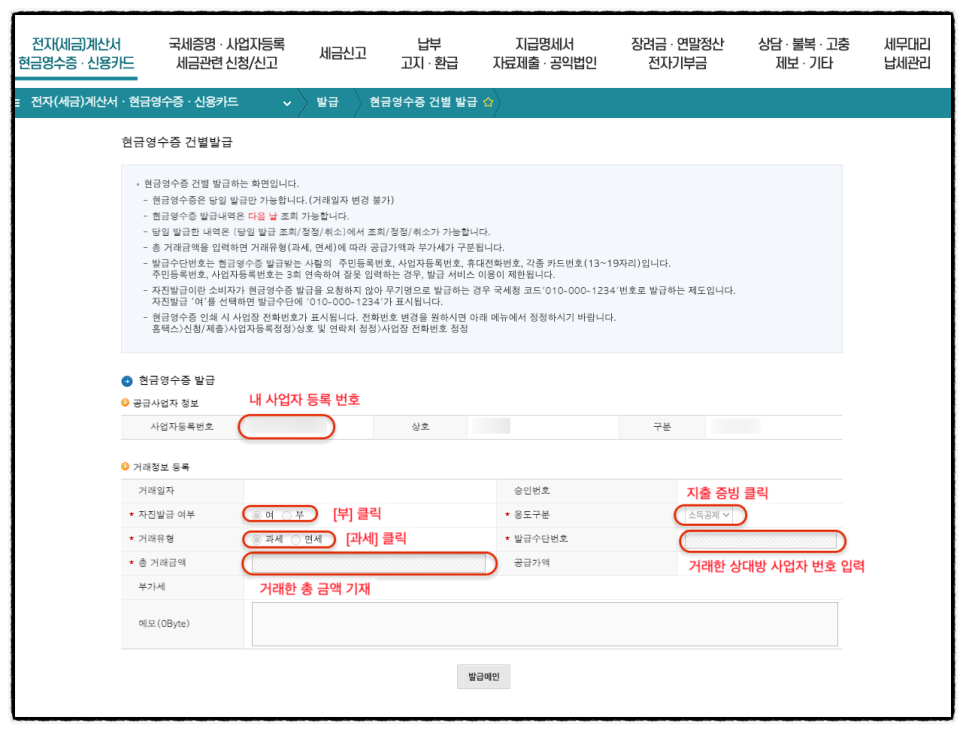
If you access the individual cash receipt issuance page, you will see a page like the one above.
When the consumer is a business ownerPlease select [Proof of Expense] as the purpose category.
Please enter the counterparty's business registration number in [Issuance Method Number].
Please enter the total cash amount transacted with the other party in the Total Transaction Amount field.
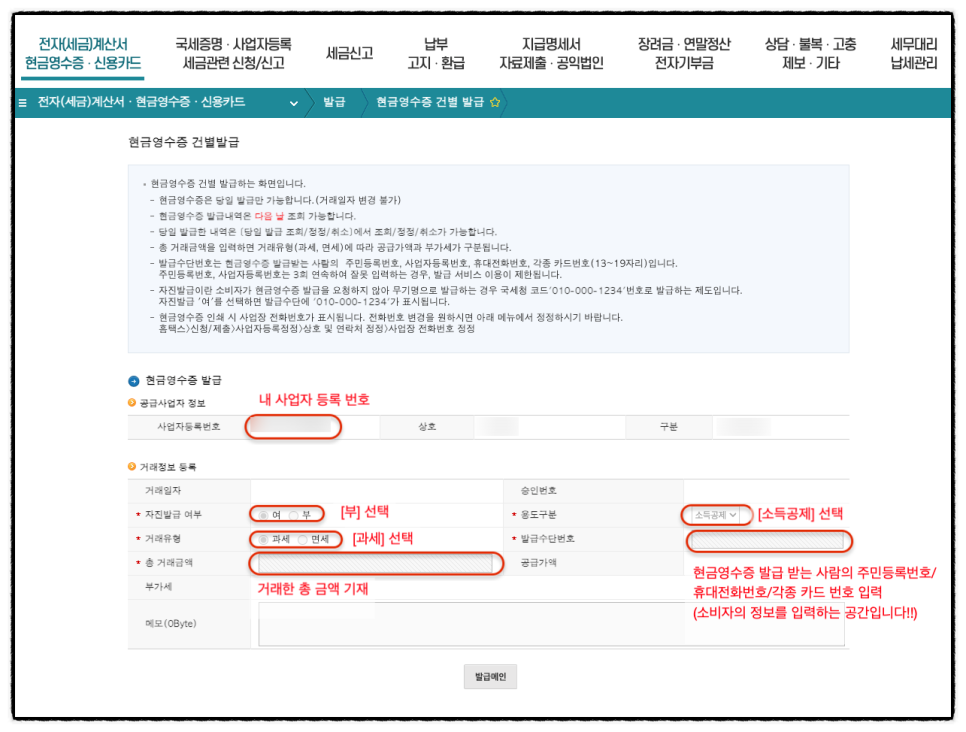
If the consumer is a general publicPlease select [Income Deduction] as the usage category.
Please enter the transacting consumer's Resident Registration Number, mobile phone number, or various card number in [Issuance Method Number].
Please enter the total cash amount transacted with the other party in the Total Transaction Amount field.
If you wish to modify the details of your cash receipt request, corrections can be issued for receipts issued on the same day.
If you discover parts that need correction the next day, you must delete the cash receipt that has already been issued and proceed with re-issuing it.
Please note that you can check the issuance status starting from the following day, not the same day!
If a customer wishes to receive a cash receipt directly after payment is complete, we can assist you by having it issued by the National Tax Service, taking a screenshot, and sending it via email, KakaoTalk, or text message, or by printing it out and delivering it to them!

TIP
Voluntary issuance refers to a system where a cash receipt is issued anonymously with the National Tax Service code 010-000-1234 when the consumer does not request a receipt.
Even if the customer does not request a cash receipt, businesses dealing with consumers are obligated to issue cash receipts for transactions of 100,000 won or more.
For transactions of 100,000 won or more, please be sure to record the transaction amount and issue a cash receipt! If you select [Yes] for voluntary issuance, 010-000-1234 will automatically be displayed as the issuance method.
※ If you have a card payment terminal, cash receipts can be issued through a separate service or app, so please refer to the service provided by your device!

An account opened in another person's name is called a 'borrowed account,' and since the introduction of the Financial Transactions Act in 1993, the opening and use of borrowed accounts are currently illegal.
Opening an account using another person's name and omitting sales by depositing and withdrawing money through that bank account is considered tax evasion.
Occasionally, due to a lack of knowledge, some people use the accounts of family members or acquaintances instead of the business owner.
However, even if the purpose was not tax evasion, you must be careful as it may be legally viewed as such.
If the use of a nominee account is discovered, you may become subject to a tax audit, and if you obtained illegal profits, additional penalties may be imposed on top of the original tax payable.
In addition, please be advised that not only the individual involved in the nominee account, but also everyone who engaged in illegal transactions, held the account, used the account, and created the account are subject to legal punishment and may face imprisonment of up to five years or a fine of up to 50 million won under the Real Name Financial Transactions Act.🚨
You must make sure to make deposits and withdrawals through your own account—specifically a business account registered in your name—to ensure that the transaction is legal and avoids any issues.
Many IP holders are starting character businesses for greater growth.
However, since it is your first time, it may feel unfamiliar, and I think there might be many things you miss!
We hope you conduct healthy transactions with more consumers and grow your character using the proper tax knowledge provided by Inner Booth.
Inner Booth always supports the characters' dazzling growth :-)
Summary of Essential Tax Knowledge
Simplified Taxpayer: Business owners with annual sales of 48 million won or less than 80 million won
General taxpayer: Business owner with annual sales of 80 million won or more
Cash Receipt: A receipt issued for amounts paid in cash (issuing cash receipts is mandatory for businesses)
Cash Receipt Issuance Method: Issued via the National Tax Service / Automatically issued via card terminal
Nominee account: An illegal account opened under another person's name
You May Also Like

August 18, 2026

August 11, 2026

January 7, 2026
How about these characters?